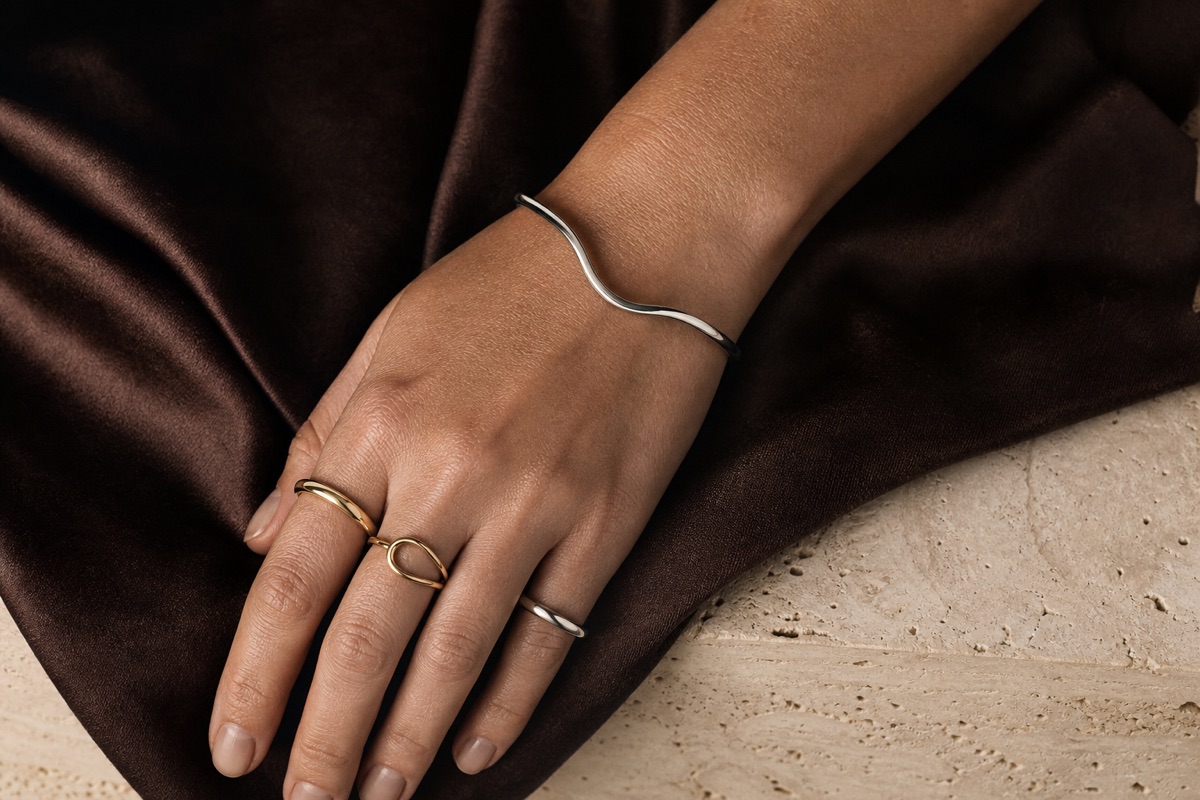
This guide explains common jewelry material categories in general terms. The exact composition, finish, treatment, dimensions, and care requirements for each piece must be confirmed on its product page.
Material 01
Sterling Silver
A silver alloy commonly used for jewelry. The exact silver content, alloy composition, hallmarking, finish, and any protective coating are product-specific.
What to consider
Can develop surface darkening depending on wear and environment
May be polished differently depending on finish and construction
Should be stored dry and separately
General care
Wipe with a soft, dry cloth. Use a silver-care product only after confirming compatibility with the alloy, finish, gemstones, and full construction.
Material 02
Gold Vermeil
A category generally describing gold applied over a sterling silver base. Definitions and minimum requirements differ by market, so each product needs exact specifications.
What to consider
Appearance depends on gold tone, finish, and application specification
The surface may change with friction, moisture, cosmetics, and wear
Base metal and surface details should be disclosed together
General care
Avoid water, cosmetics, chemicals, and abrasive polishing. Wipe lightly with a soft, dry cloth and store separately.
Material 03
Solid Gold
Gold alloyed for jewelry in a stated fineness and colour. Composition, fineness, hallmarking, and surface finish vary by product.
What to consider
Colour and physical properties depend on the full alloy composition
Surface marks can develop through normal contact and wear
Professional inspection may be appropriate for settings and structural components
General care
Store separately and clean only with a method confirmed for the alloy, finish, gemstones, settings, and any bonded components.
Material 04
Stainless Steel
A family of metal alloys used for some jewelry designs. Grade, finish, coatings, and surface treatments determine product-specific characteristics.
What to consider
Available in different grades and finishes
Coated and uncoated surfaces require different disclosures
Suitability cannot be inferred from the category name alone
General care
Wipe with a soft cloth and avoid abrasive methods. Follow the product instructions for any coating, inset material, or mixed-metal construction.
Material 05
Cubic Zirconia
A manufactured crystalline material used as a decorative stone. Cut, colour, setting, coating, and dimensions are product-specific.
What to consider
Produced in a range of cuts, sizes, and colours
Appearance depends on cut, setting, lighting, and wear
Care must account for the surrounding metal and construction
General care
Avoid impacts and abrasive contact. Use only a cleaning method confirmed for the stone, any coating, the setting, and the complete piece.
Material 06
Lab-grown Gemstones
Gemstone materials produced in a controlled environment. The specific gemstone identity, growth method, treatments, grading, and disclosures vary by product.
What to consider
Identity and properties depend on the named gemstone material
Treatment and grading information should be disclosed when relevant
Care guidance must be specific to the stone and setting
General care
Protect from knocks and use only care methods confirmed for the named gemstone, treatments, setting, and surrounding materials.
Material 07
Natural Gemstones
Mineral or organic gemstone materials formed in nature. Identity, origin, treatments, grading, and natural characteristics require product-level disclosure.
What to consider
Colour, pattern, inclusions, and surface features may vary
Durability and care differ significantly by gemstone
Treatments and certification should never be assumed
General care
Follow guidance for the confirmed gemstone and its treatments. Avoid steam, ultrasonic equipment, soaking, heat, or chemicals unless compatibility is explicitly confirmed.
Material 08
Pearls
Organic gems formed within molluscs. Type, cultivation method, treatments, surface characteristics, size, shape, and colour vary by product.
What to consider
Surface, colour, shape, and lustre can vary from pearl to pearl
Potentially sensitive to cosmetics, chemicals, abrasion, and dry or humid conditions
Stringing and fastening methods affect care and servicing needs
General care
Put pearls on after cosmetics have dried, wipe gently after use, store away from abrasive surfaces, and avoid soaking unless product-specific guidance allows it.
Next step
Care starts with the full material list
Review product-specific information first, then use the care guide for practical handling and storage guidance.